Africa’s Blue Economy is expanding rapidly but beneath the growth of ports and maritime infrastructure lies a deeper question of who benefits, and at what cost?
Maritime with Ezinne
A weekly column on Africa’s Blue Economy and maritime development, with attention to how ports, coastal infrastructure, and policy decisions interact with the lived realities of communities along the continent’s coastlines.
The maritime industry is traditionally a capitalist space. Maritime states, whether in Africa or elsewhere, invest heavily in seaports, shipping, logistics, fisheries, and related infrastructure because of the economic value these activities generate. Through imports and exports, maritime services, harbours, ports, cargo handling, and the taxes that come from the use of these facilities, the maritime industry has become a significant revenue spinner for governments. Economic empowerment remains a strong determinant of state investment priorities, and the maritime sector sits at the centre of this calculation.
Although the National Bureau of Statistics (NBS) in Nigeria does not assess the maritime industry as a single economic entity-possibly because of its multisectoral nature and the diversity of activities that fall within it- the indicators it documents cannot be ignored. Across trade, transportation, logistics, fisheries, customs-related activity, and other maritime-linked services, the evidence points to a sector deeply connected to economic value, revenue generation, and national development.
Whether viewed through customs revenue, port charges, shipping activity, logistics services, or the sheer volume of trade that moves through the maritime domain, the maritime space is not merely geographical; it is fundamentally an economic space. Perhaps that is why it has traditionally been driven by the logic of growth, revenue, and profit.
But on the ground, the issue is not that government does not know empathy. It often knows both business and empathy. The issue is that it listens more to business. And when a location can generate significant revenue- even a million in value- it becomes a priority, and development moves in.
Across coastal states, the expansion of maritime infrastructure has gone hand in hand with the reconfiguration of coastal space. Once a location is seen as strategically or economically important, competing interests emerge- state agencies, private investors, and industrial actors. What follows is a gradual transformation of space, often justified in the language of national development and economic growth.
The process often ends at engagement through community representatives, where discussions are reduced to compensation for land acquisition. But what is at stake is far more than land. For fishing communities in particular, displacement can mean a rupture of livelihood systems, a distortion of historical continuity, and an erosion of culture. It interrupts inherited knowledge of the water, breaks social networks built across generations, and weakens long-standing relationships between people and their maritime environment.
In maritime political ecology, this process has been described as ocean grabbing- the appropriation of ocean and coastal spaces, resources, and access rights by powerful actors in ways that undermine small-scale fishing communities and their livelihoods (Bennett et al., 2015). It is not only about development impact, but about the reallocation of ocean space from customary use to state and commercial interests.
In Nigeria, these dynamics are increasingly visible in the expansion of coastal infrastructure and maritime industrialisation.
The Lekki–Epe corridor, including the Lekki Deep Sea Port and surrounding industrial investments, reflects a reconfiguration of coastal space for capital-intensive maritime development. While these projects are framed within national economic and trade objectives, they also place pressure on wetlands, informal settlements, and artisanal fishing systems, gradually restricting traditional coastal access (Environmental and Social Impact Assessment of the Lekki Deep Sea Port Project, 2015; Adeyemi et al., 2020; Akinola, 2018).
Similarly, the proposed Badagry Deep Sea Port has generated public concern around consultation, resettlement frameworks, and the future of coastal livelihoods. Communities often point to displacement risks, ecological disruption, and questions around whether compensation truly reflects what is being lost.
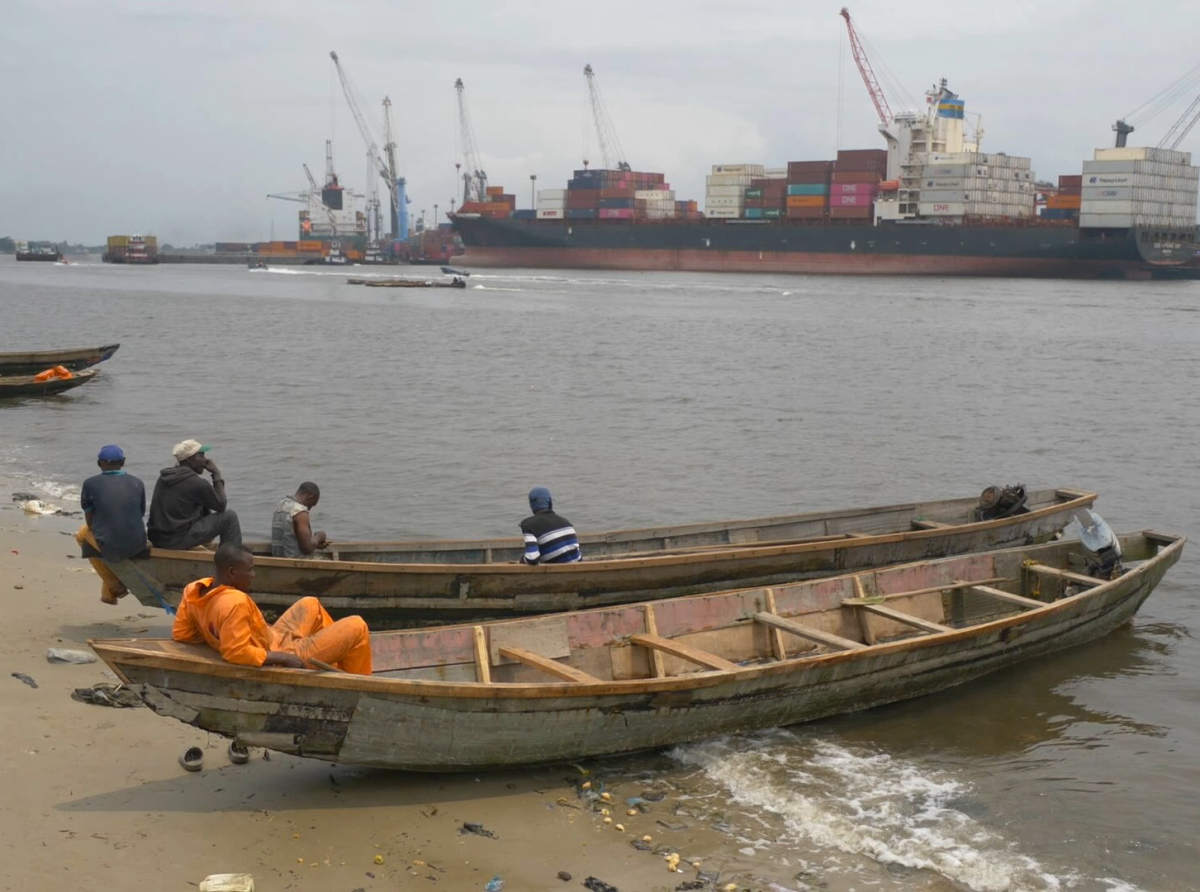
The Snake Island and Lagos Harbour axis further shows the slow enclosure of coastal and navigable space through industrial expansion. Over time, increased maritime infrastructure in this corridor has reduced access to waterways and placed pressure on surrounding communities whose livelihoods depend on fishing and informal coastal activity.
In the Niger Delta, the situation is even more complex. Beyond oil pollution, pipelines, terminals, and security-controlled zones have reshaped access to fishing grounds and disrupted riverine mobility systems, producing both ecological damage and social disruption.
This is where the debate becomes deeper than development.
While the Land Use Act vests control of land in the state, coastal governance cannot be reduced to legal ownership alone. Coastal spaces are also livelihood systems, cultural landscapes, and historical settlements shaped by long-standing relationships between people and the water.
So, the challenge becomes clear: legal authority versus social legitimacy.
On paper, government can allocate land in the public interest. In practice, acceptance depends on whether communities feel meaningfully engaged- not just informed after decisions have already been made.
This is why compensation alone often falls short. It recognises land, but not livelihood systems, identity, or intergenerational ties to coastal environments. Increasingly, maritime governance literature- especially as the world embraces the Blue Economy- emphasises early engagement, participatory planning, livelihood restoration, and in some cases, Free, Prior and Informed Consent (FPIC) as a benchmark for legitimacy.
Comparative African experience shows different outcomes. The expansion of the Port of Maputo in Mozambique, particularly from its post-2003 concession phase, is often referenced as a case where resettlement and stakeholder engagement were more structured under development finance frameworks. While concerns remain around livelihood restoration, it reflects a more formal application of environmental and social safeguards compared to many regional projects.
Globally, frameworks such as the IFC Performance Standards (2012), the World Bank Environmental and Social Framework (2018), and FPIC principles under international human rights norms all point in one direction: development must go beyond compensation and begin to address participation, rights, and long-term social continuity.
The real question, therefore, is not whether maritime development should happen. It will. Ports will be built, coastal infrastructure will expand, and maritime trade will continue to grow.
The real question is this: can this growth happen without reproducing patterns of exclusion, displacement, and loss for coastal communities?
If the Blue Economy is to mean more than a repackaged form of maritime capitalism, then it must show that economic expansion can coexist with cultural survival, livelihood security, and meaningful participation.
Maritime with Ezinne
By Ezinne Chinwe Azunna